
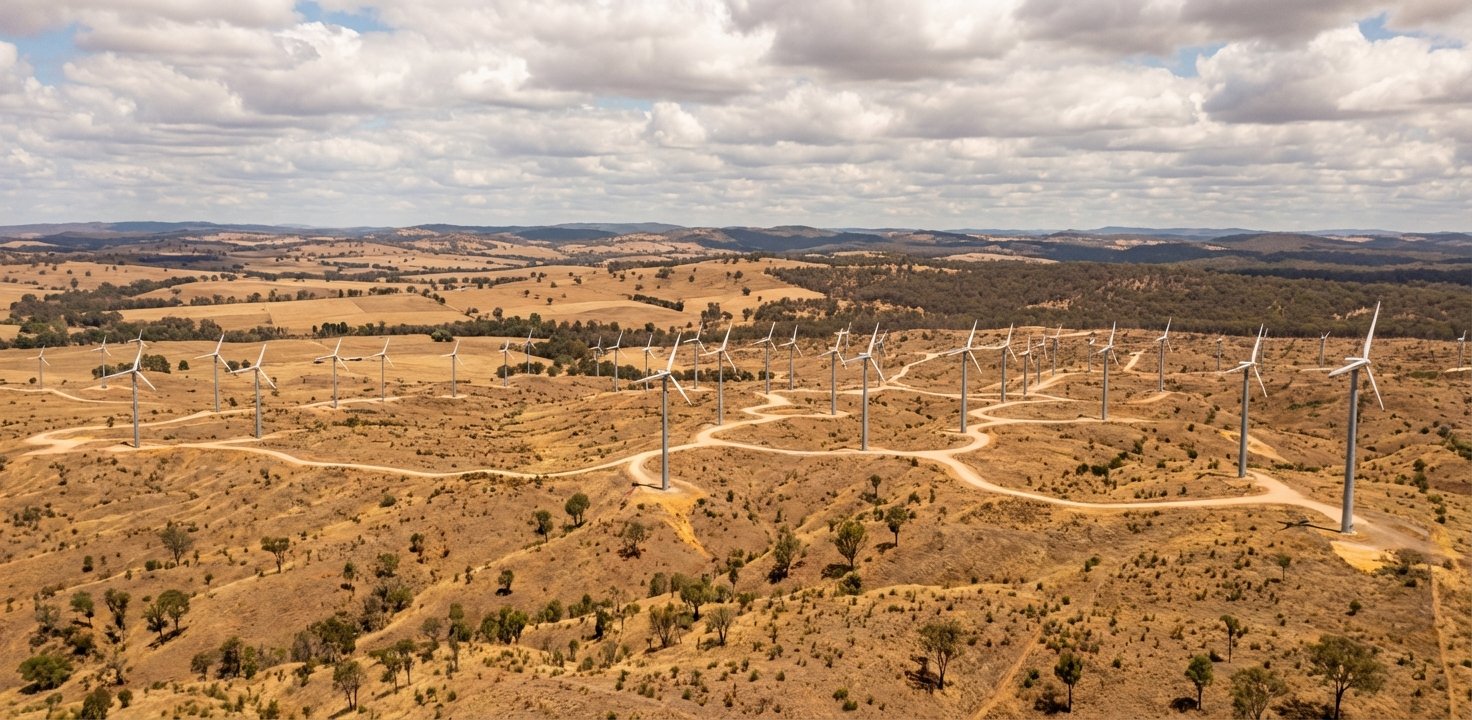
Boomer Green Energy Hub
Snapshot
The Boomer Green Energy Hub (BGEH) is a large-scale renewable energy project located in Central Queensland, involving the construction and operation of a wind farm with battery energy storage and associated transmission and civil infrastructure. At an estimated capital investment of approximately $3 billion, BGEH is one of the most significant renewable energy projects in Queensland’s development pipeline.
Turnbull Engineering was engaged by Ark Energy as the lead civil and structural designer to deliver the 30% reference design, building on the team’s relationship and experience from the Richmond Valley Solar Farm.
Location
Central Queensland
Client
Ark Energy
Project type
Large-scale wind farm with battery energy storage and associated infrastructure
Turnbull’s role
Lead civil & structural reference designer for the 30% reference design
Estimated capex
~$3 billion
Timeline
2025
Status
Reference design delivered; project in development

Project Overview
The project’s infrastructure includes wind turbine generators, 33 kV underground reticulation, substations, a Battery Energy Storage System (BESS), an operations and maintenance (O&M) facility, transmission infrastructure, and approximately 150 kilometres of access roads across a large site in challenging terrain.
The design was structured across four Design Packages: Public Road Upgrades (DP1), Permanent Facilities (DP2), Wind Turbines, Temporary Facilities, Access Tracks and Hardstands (DP3), and Transmission Infrastructure (DP4), enabling staged delivery and efficient interface management between civil, structural, and electrical disciplines.
Scope
Services
Turnbull Engineering delivered the full civil and structural design scope for the 30% reference design, spanning site access, enabling infrastructure, and specialist assessments across the project’s four design packages.
Access roads and tracks
Earthworks
Pavements
Drainage
Fencing, gates, and cattle grids
Foundations (substation, BESS, and O&M facility)
Wind turbine foundations
Transmission line structures and access tracks
Flooding assessment
Mass haul analysis
Erosion and sediment controls
Project Highlights
-
Continuity from Richmond Valley Solar Farm
Key team members from RVSF were retained for BGEH, bringing direct client knowledge and project experience into a significantly larger and more complex wind farm design scope, maintaining a productive relationship with Ark Energy and avoiding the learning curve of a new team.
-
Designing in challenging terrain
Drawing on experience from Hills of Gold Wind Farm, Turnbull optimised road alignments using geological mapping to reduce earthworks and minimise site footprint across steep terrain. Rather than producing extensive cross-section drawing sets, Turnbull provided colour-graded road gradient outputs and depth-from-surface point files that allowed Ark Energy to interrogate the design directly.
-
3D federated model for real-time design coordination
Turnbull delivered a federated 3D model coordinating access roads, substations, wind turbine locations, BESS, and O&M facilities, exported fortnightly via a web browser. This gave Ark Energy continuous visibility of the evolving design and allowed coordination issues to be identified and resolved early.
-
Improving client satisfaction across engagements
Ark Energy’s client satisfaction surveys showed improving performance scores from the RVSF concept design (April 2024) through to the RVSF 30% reference design (January 2025), reflecting Turnbull’s commitment to incorporating feedback and continuously improving delivery on this client relationship.
-
One of Queensland’s largest renewable energy projects
At an estimated $3 billion capex, BGEH is among the largest wind energy projects in Queensland’s development pipeline. Turnbull’s scope spans the full project footprint, from public road upgrades through to transmission tower foundations, delivered across a 109-day reference design program.

By the numbers
~150 km
access roads and hardstands
~186 km²
catchment modelled
~14 km
275 kV transmission line
~$3b
estimated capex